
AI writes it. AI reads it. Nobody's actually looking.
When both sides of hiring hand the work to machines, the person gets lost in the middle. Here's how to put them back.
CanvasedIn Team ·
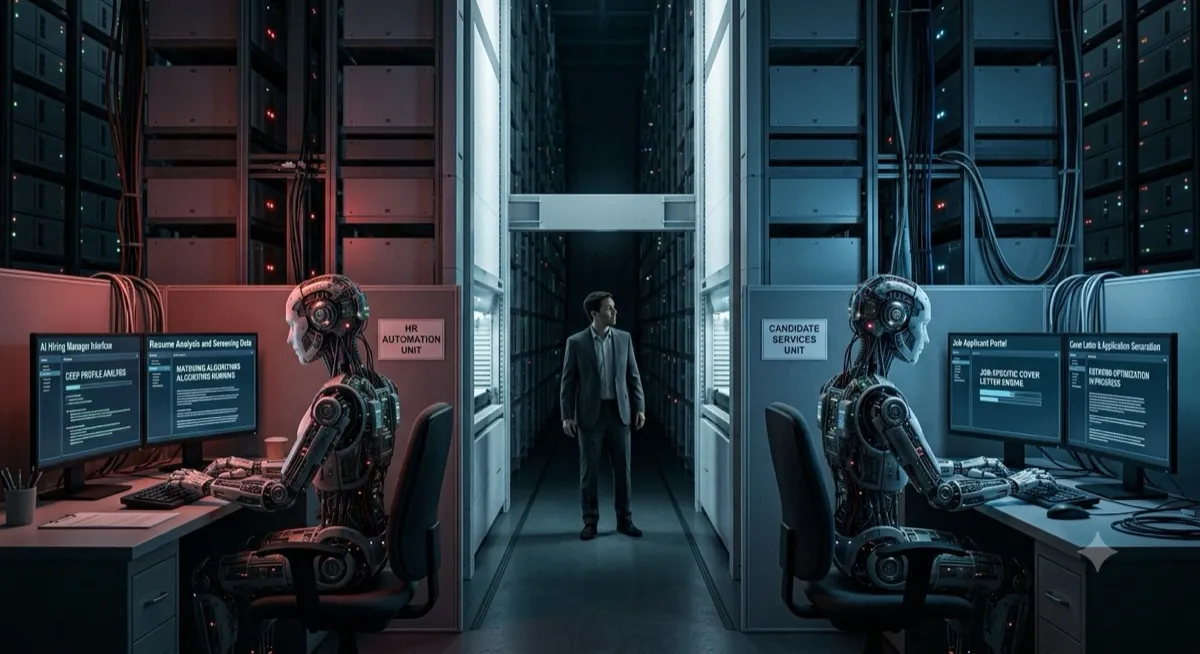
A candidate pastes a job description into an AI tool. Out comes a tailored résumé and a cover letter with every keyword in the right place. They apply to forty roles that evening.
On the other side, a company's screening software reads the thousands of applications it received that week. It ranks them against the same keywords and passes a shortlist to a recruiter.
So a machine wrote the application, and a machine decided who got through. At no point did anyone look hard at what the person has actually done.
Why it keeps getting worse
This isn't a story about technology being bad. It's about what happens to a signal when it becomes free.
A résumé was never proof of anything. It was a set of claims, and the reader had to decide how much to believe. But writing a good one used to take effort, and that effort told you something about the person.
Now anyone can produce a polished, keyword-matched résumé in seconds. Polish no longer tells you anything.
Companies respond by tightening their filters. Candidates respond by sending more applications. Both sides spend more time and money, and both learn less about each other. Each side's fix makes the other side's problem worse.
Who loses
- Strong people who don't play the volume game. The person who is already doing excellent work, is quietly employed, and isn't firing off forty applications never enters the pile.
- Companies. They end up choosing from the people who applied the most, not the people who are best.
- The humans on both sides. Recruiters spend their days sorting text they don't believe. Candidates send applications into silence.
What brings the signal back
If claims are free, you need evidence that someone other than the author stands behind.
That is what a Canvas is built around. Every work item on CanvasedIn is quantified, with what was done, at what scale and with what result. Each skill shows what backs it:
- Used in [work item]: the skill appears in a piece of work on the Canvas.
- Vouched by [name]: someone who worked with them confirms it, and their relationship is shown.
- Assessed [month year]: they completed an assessment for it on the platform.
A recruiter can see what stands behind each claim before they reach out. A skill with nothing behind it carries no evidence line. Nothing pretends a claim is proof.
Put a human back in the room
The second problem is the process. Mass applications and mass screening both work because nobody has to choose.
On CanvasedIn, choosing is required:
- The company reaches out, not the other way round. Professionals don't apply into a pile.
- Every request carries real context. The role, pay range and evaluation plan are attached upfront, with a justification written fresh for that person. Generic or copy-pasted text is blocked before it sends.
- Outreach is limited. Each recruiter seat has 20 requests a month, so a recruiter has to pick who is worth writing to.
- The professional sets the terms. If they say yes, the evaluation runs inside the Eval Room on limits they chose, and the company owes written feedback within 5 days.
The limits are deliberate. They are what keep outreach worth opening.
We use AI too
AI isn't the villain here. On CanvasedIn it helps turn your résumé into a draft Canvas, which saves hours. The problem is when AI is the only thing in the room. Here, it does the drafting, while the evidence, the company's reasons for reaching out, and the final decision all belong to people.
What you can do now
If you're a professional: put your best work somewhere it can be checked, not just claimed. Ask a former colleague to vouch for it. You'll have something an AI-written résumé can't copy.
If you're a recruiter or founder: read three real pieces of work before you read a keyword match. Reach out to fewer people, with a reason that is true for each of them.
AI can write a hundred applications before lunch, and another AI can read all of them by dinner. But hiring still comes down to one person deciding to trust another, and that needs evidence and a real person looking.
Build your Canvas once. Control when it's seen. Create your Canvas